


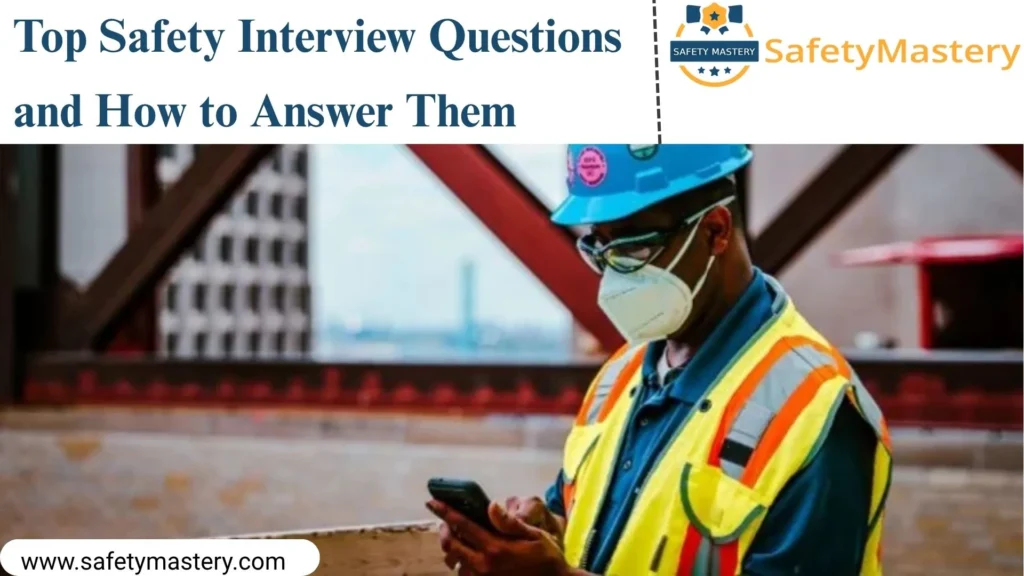
Top Safety Interview Questions and How to Answer Them (With Sample Answers)
If you’re preparing for a Safety Officer, HSE Engineer, or EHS Manager interview, you’re likely wondering what kind of safety interview questions you’ll face.
Employers want professionals who not only know safety concepts but can also apply them in real-world situations.
In this article, we’ll cover the top safety interview questions and answers that can help you ace your next interview and boost your confidence.
Answer:
Safety means protecting people from injury, illness, or harm by identifying hazards, assessing risks, and controlling them effectively.
Example:
“Safety is the condition of being free from hazards that can cause injury or ill health. It involves identifying risks, controlling them, and ensuring every worker goes home safely every day.”
Answer:
- Hazard: Anything that can cause harm (like chemicals, electricity, or working at height).
- Risk: The chance or likelihood that harm will occur due to exposure to a hazard.
Example:
“Electricity is a hazard, but the risk depends on exposure — such as touching a live wire without insulation.”
Answer:
- Conduct safety inspections and audits
- Identify and eliminate hazards
- Deliver safety training and toolbox talks
- Investigate accidents and near misses
- Maintain safety records and reports
- Ensure compliance with safety regulations
Example:
“As a Safety Officer, my role is to maintain a safe work environment by conducting inspections, providing safety awareness, and ensuring compliance with legal standards.”
Answer:
A risk assessment is the process of identifying hazards, analyzing their potential impact, and deciding how to control or eliminate them.
Five Steps of Risk Assessment:
- Identify hazards
- Determine who might be harmed and how
- Evaluate risks and decide on control measures
- Record findings and implement them
- Review and update regularly
Example:
“Before any high-risk work, I conduct a risk assessment to evaluate possible dangers and ensure preventive controls are in place.”
Answer:
The Hierarchy of Controls ranks control measures from most to least effective:
- Elimination – Remove the hazard
- Substitution – Replace the hazard
- Engineering Controls – Isolate people from the hazard
- Administrative Controls – Change the way people work
Personal Protective Equipment (PPE) – Protect the worker with gear
Example:
“We always aim to eliminate or substitute the hazard first, using PPE only as a last line of defense.”
Get Courses Details
6. What Is a Permit to Work System?
Answer:
A Permit to Work (PTW) system is a formal written process used to control hazardous work such as hot work, confined space entry, or electrical maintenance.
Example:
“A PTW ensures high-risk tasks are carried out safely by defining responsibilities, precautions, and authorized personnel.”
7. What Is a Near Miss?
Answer:
A near miss is an unplanned event that could have caused injury, damage, or loss but did not, either by chance or timely intervention.
Example:
“If a tool falls from height but misses a worker, it’s a near miss. Reporting near misses helps prevent real accidents in the future.”
8. What Should You Do If an Accident Occurs at the Site?
Answer:
- Stop the work immediately and make the area safe
- Provide first aid (if trained and it’s safe to do so)
- Inform the supervisor or safety officer
- Secure the area to preserve evidence
- Record and report the incident for investigation
Example:
“In case of an accident, my priority is to prevent further harm, report promptly, and assist in the investigation to avoid recurrence.”
9. What Are the Common Causes of Workplace Accidents?
Answer:
- Unsafe acts (e.g., not using PPE)
- Unsafe conditions (e.g., poor housekeeping, faulty tools)
- Lack of training or supervision
- Human error
- Neglect of safety procedures
Example:
“Most workplace accidents happen due to unsafe behavior and poor supervision — that’s why training and awareness are crucial.”
10. What Is PPE and Why Is It Important?
Answer:
PPE (Personal Protective Equipment) includes equipment like helmets, gloves, goggles, safety shoes, and harnesses designed to protect workers from hazards.
Example:
“PPE acts as the last line of defense. While it doesn’t eliminate hazards, it reduces exposure to risks and prevents injury.”
11. What Are the Steps to Conduct a Safety Audit?
Answer:
- Plan the audit
- Inspect the workplace and processes
- Identify non-conformities
- Recommend corrective actions
- Follow up on implementation
Example:
“A safety audit helps evaluate the effectiveness of the safety management system and ensures continuous improvement.”
12. What Is the Role of Safety Training?
Answer:
Safety training educates employees about workplace hazards, emergency procedures, and safe work practices to prevent incidents.
Example:
“Effective training builds awareness and changes behavior — transforming safety from a rule into a habit.”
13. What Is a Toolbox Talk?
Answer:
A toolbox talk is a short, informal safety meeting conducted before starting work to discuss potential hazards and safe practices for the day’s activities.
Example:
“Regular toolbox talks improve communication and remind workers to stay alert and safe on the job.”
14. What Is an Accident Investigation?
Answer:
Accident investigation is the process of finding the root cause of an incident to prevent it from happening again.
Example:
“The goal of an investigation isn’t to assign blame but to learn and implement corrective measures to enhance safety.”
15. How Do You Promote Safety Culture in the Workplace?
Answer:
- Lead by example
- Conduct regular training
- Reward safe behavior
- Encourage hazard reporting
- Communicate safety goals clearly
Example:
“Safety culture grows when management and workers share responsibility — it’s about teamwork, awareness, and accountability.”
Final Thoughts
Preparing for a safety interview is about understanding concepts and showing real-world application. When you answer with confidence and logic, you demonstrate not just knowledge — but leadership.
Safety is not just a policy; it’s a commitment to life.
Take the next step in your safety career.
Join globally recognized safety programs like Level 7 PSM or Level 7 OHSM Certification and become a certified safety leader.